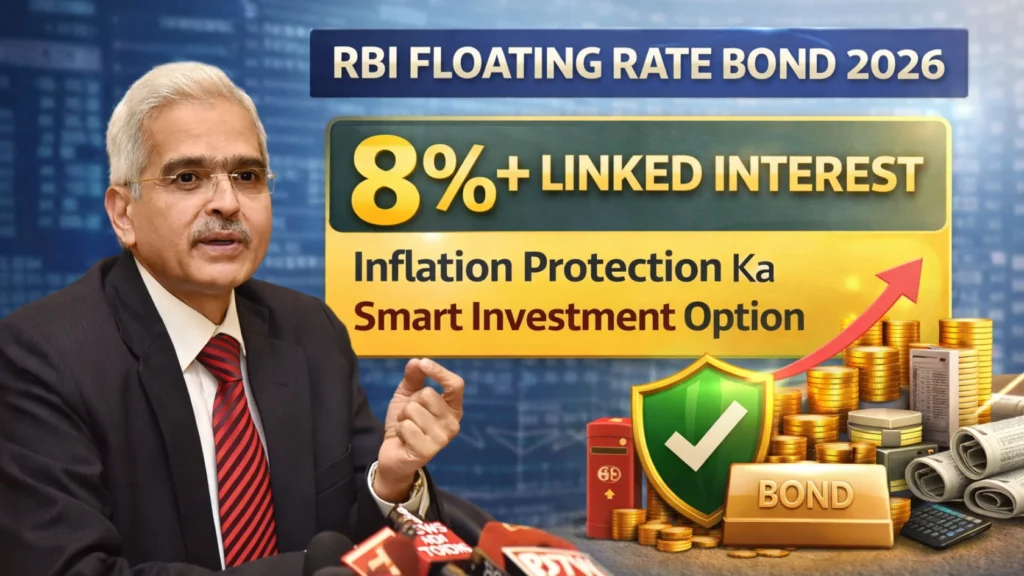
RBI Floating Rate Bond 2026: Conservative investors looking for stable returns with protection against interest rate fluctuation are increasingly exploring RBI Floating Rate Bonds instead of locking funds at fixed bank FD rates. With interest rate linked to government savings schemes benchmark, these bonds offer dynamic returns that adjust periodically. The expected yield of 8 percent plus makes it attractive for retirees and income-focused investors seeking better protection against inflation.
Floating Interest Rate Structure And Tenure
RBI Floating Rate Savings Bonds generally come with a 7-year tenure. The interest rate is linked to National Savings Certificate rate plus a fixed spread, and it resets every 6 months. If NSC rate changes, bond interest adjusts accordingly. Current yield expectation remains above 8 percent depending on government notification. Interest is paid semi-annually directly into investor’s bank account.
Also Read: Post Office FD 2026: 7.5% Guaranteed Return Ke Saath 5-Year Government-Backed Safe Plan
Inflation Protection And Rate Reset Benefit
Unlike fixed deposit where interest remains constant for entire tenure, floating rate bond adjusts with market-linked benchmark. If interest rate environment rises due to inflation, bond coupon may increase accordingly at reset date. This structure provides partial inflation hedge and reduces risk of locking money at low rate during rising interest cycle.
Government Backing And Capital Safety
These bonds are issued by Reserve Bank of India on behalf of Government of India, ensuring sovereign guarantee. Capital safety remains very high compared to corporate bonds or NBFC deposits. There is no market price fluctuation risk for investors holding till maturity since redemption happens at face value.
Liquidity And Withdrawal Conditions
RBI Floating Rate Bonds are not tradable in secondary market and cannot be pledged as collateral. Premature withdrawal is generally restricted, though senior citizens may get early exit option after certain lock-in period with penalty. Investors should consider liquidity needs before investing due to 7-year lock-in nature.
Income Example And Return Impact
For example, investing ₹5 lakh at 8.2 percent interest may generate around ₹41,000 annual income before tax, paid in two instalments. If benchmark rate increases at reset, annual income may rise accordingly. Compared to fixed 7 percent bank FD, floating rate bond may provide better return in rising rate environment while maintaining government-backed safety.
Disclaimer: Final interest reset formula, benchmark linkage, lock-in rules, taxation treatment, and premature withdrawal conditions depend on official RBI notification and government guidelines. Investors should verify latest details before making investment decisions.